Do I really need a senior move manager, or can I do it myself?
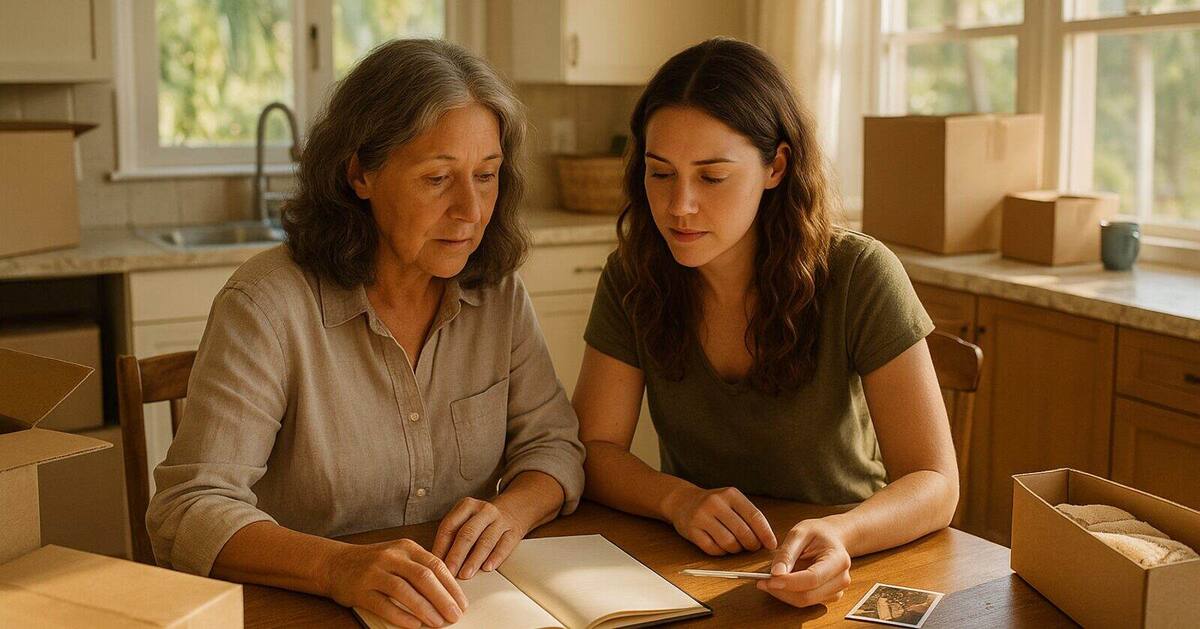
Most families ask this question quietly, usually after something has already gone sideways. A box of irreplaceable photos ends up donated by accident. A piece of furniture that was supposed to go to a grandchild disappears on moving day. Or everyone in the family agrees to help, and then one by one they can't make it, and Mom is standing in an empty house with no idea what happens next. If you're weighing a DIY approach against hiring professional help, this is the honest guide you deserve.
The question is completely reasonable
Nobody wants to spend money they don't need to spend. And on the surface, a senior move can look a lot like any other move: pack boxes, load a truck, unload at the new place, done. If you've moved your own household before, you might reasonably wonder what the big deal is.
The big deal, it turns out, is usually not the physical moving part. It's everything that surrounds it.
A typical senior move in Sarasota County involves decades worth of accumulated belongings in a home that may not have been sorted through in years. It often involves a transition to a smaller space, which means hard decisions about what to keep, what to give away, what to sell, and what to donate. It involves coordinating movers, timing with a new community's move-in schedule, arranging for donation pickups, possibly staging or cleaning the original home for sale, and making sure the new space is actually livable and familiar-feeling from day one.
That's a lot of moving parts, and most of them have to happen in a specific order, within a tight window, at a time when the person moving is often already dealing with a health change, a grief process, or simply the emotional weight of leaving a home they've lived in for thirty years.
What DIY actually looks like in practice
Let's be straightforward about what you're signing up for if you decide to manage a senior move yourself.
The sorting and downsizing alone is a multi-week project. A home with 40 or 50 years of belongings doesn't sort itself. Adult children who live locally and have flexible schedules can make this work, but it takes sustained effort over many weekends. The emotional component is real, too. Sorting a parent's belongings while they're still living and involved in every decision is different from sorting an estate after the fact. Feelings get complicated. Decisions that seem simple (do we keep the china?) turn into long conversations.
Coordination with communities has its own learning curve. If your family member is moving into an independent living community, assisted living, or a memory care residence, that community has its own move-in rules. There are specific days and times when moves are allowed. There are elevator reservations, loading dock procedures, and in some cases, restrictions on what can come in. If you haven't done this before, you'll be learning those rules while also managing everything else.
Movers don't always do what you expect. A standard moving company will move boxes and furniture. They will not unpack, arrange furniture, hang pictures, or set up the kitchen. If you want your mother's new apartment to feel like home on day one, rather than a storage unit full of her things, someone has to do that setup work. That's usually the family, which means more hours and more trips.
The day-of logistics are genuinely stressful. Even well-planned moves encounter surprises: a piece of furniture that won't fit through a doorway, a delivery that arrives at the wrong time, a family member who needs to leave earlier than expected. When you're the one managing all of it while also supporting an elderly parent through a difficult transition, the stress adds up fast.
Where Sarasota County adds its own wrinkles
Florida moves have some local specifics worth knowing. The heat and humidity here are not trivial, especially for older adults and for movers working in June through September. Timing matters. Many families in this area are also dealing with seasonal schedules: a lot of adult children visit or live nearby during winter months but are not local in the summer, which can affect when a move realistically happens.
Sarasota County also has a large and active network of senior living communities, from downtown Sarasota to Venice to North Port and Englewood. Each community is its own world with its own policies. Families who are new to this process often don't know what questions to ask, and communities don't always volunteer information about move-in logistics until you're already in the middle of scheduling.
If you're still figuring out the bigger picture of what a move like this actually involves from start to finish, our post on what a senior move manager actually does in Sarasota County walks through the full scope of the work in plain language.
Signs that DIY is a reasonable choice
There are absolutely situations where families handle senior moves on their own, successfully and with less stress than they expected. Here's what tends to make that work:
- The move involves a relatively small amount of belongings, maybe from a one-bedroom apartment or a home that has already been partially downsized.
- Multiple local family members are available and willing to commit real time over several weeks.
- The person moving is in good health, is emotionally ready, and can participate actively in decisions without becoming overwhelmed.
- The destination is straightforward: another family member's home, or a community with simple move-in logistics.
- Nobody is under significant time pressure from a health event, a lease deadline, or a home sale.
If most of those things are true, you may do just fine on your own. Plenty of families do.
Signs that professional help is worth it
On the other hand, here's what tends to tip the balance toward getting help:
- The home is large or has a significant volume of belongings accumulated over many years.
- Family members are not local, are working full-time, or have their own health or family constraints.
- The person moving has physical limitations, cognitive changes, or significant emotional difficulty with the transition.
- The move needs to happen quickly because of a health change, a fall, a hospitalization, or a memory care placement.
- There is family disagreement about belongings, which is more common than people expect and harder to navigate without a neutral third party.
- The original home needs to be sold, which adds the pressure of preparing and staging the property.
When several of these factors are present at once, the cost of professional help tends to look a lot more reasonable. Not because you couldn't figure it out yourself eventually, but because the time, stress, and potential for things to go wrong are simply higher than most families anticipate going in.
What about cost?
This is the question behind the question, usually. People want to know if professional senior move management is worth the money, which is fair.
The honest answer is that it depends on what you're comparing. If you compare the cost of a senior move manager to zero, yes, it costs more. If you compare it to what your own time is worth, plus the cost of mistakes like donation pickups for items that were supposed to stay, or movers who have to wait while decisions get made on the fly, or the emotional toll on family relationships, the math looks different.
Our dedicated post on how much a senior move manager costs in Sarasota County breaks down what you can actually expect to pay and what drives the price up or down. It's worth reading before you decide anything.
A middle path: getting partial help
One thing families don't always realize is that professional senior move management doesn't have to be all or nothing. Some families handle the sorting and downsizing themselves over several weekends, and then bring in a professional for the final coordination, the move day itself, and the setup at the new place. Others want help with the emotional and logistical complexity of downsizing but feel comfortable managing the actual moving day on their own.
A good senior move manager will work with you on the scope that actually makes sense for your situation. You don't have to hand over every piece of the process if you don't want to. If you'd like to have a straightforward conversation about what would and wouldn't be helpful in your specific case, you can get a free quote and talk it through with no obligation.
What families often say afterward
The families who do use professional help tend to say one of two things afterward. Some say they couldn't have done it without it, usually the ones who came in with a tight timeline or a very full house. And some say they probably could have managed, but they're really glad they didn't have to, because the transition itself was hard enough emotionally without also being the logistics coordinator.
Both of those are valid outcomes. The goal isn't to convince you that you need help. The goal is to help you make a clear-eyed decision based on what your situation actually is, not what you hope it will be.
If you want to understand more about who we are and how we approach this work, our about page gives you a real sense of the values behind what we do. And if you have specific questions that this post didn't answer, our frequently asked questions covers a lot of the practical details families ask about most often.
The bottom line
You might be able to do this yourself. Plenty of families do. But before you decide, be honest with yourself about the volume of work involved, the time you and your family can realistically commit, the emotional weight of the transition, and the cost of getting things wrong under pressure. A senior move is not just a logistical event. For the person moving, it is one of the biggest transitions of their life. How it goes matters, both practically and emotionally.
If there's any doubt, it's worth at least having a conversation. You may find that a little help in the right places makes a very big difference.