Choosing the right 55+ community in Sarasota County
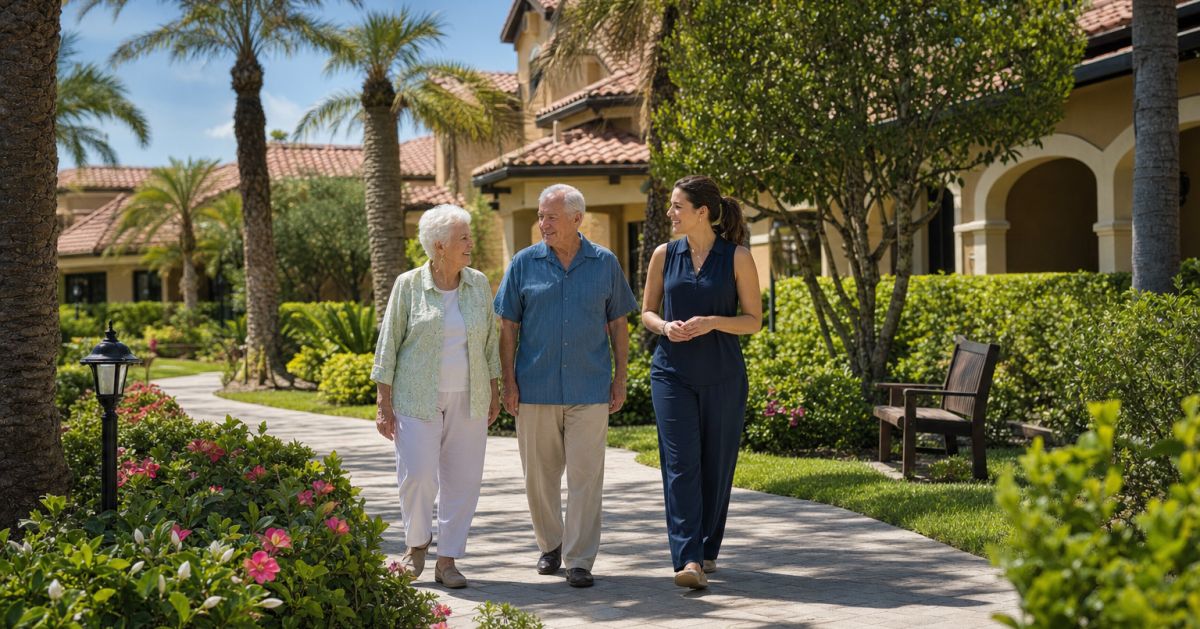
Touring a beautiful clubhouse with a sparkling pool is easy. Knowing whether that community will still fit your life five years from now is the hard part.
Sarasota County is genuinely one of the most competitive senior-living markets in Florida. Active-adult neighborhoods stretch across Palmer Ranch and Lakewood Ranch. Assisted living facilities dot Bee Ridge Road and Fruitville Road. Memory-care cottages sit quietly in Gulf Gate and The Meadows. That variety is a gift, but it also means the research burden on families is real. This guide walks you through the questions that actually matter, in the order you should ask them.
Start with the care level, not the amenities
The single most important variable is not the heated pool or the pickleball courts. It is the level of care the community is licensed to provide, and whether that level matches where you are today and where you are likely to be in a few years.
Florida's Agency for Health Care Administration (AHCA) licenses senior residential settings in several distinct tiers:
- Independent living / 55+ communities. No licensed care is included. Residents must be able to manage all activities of daily living on their own. These communities include the large active-adult neighborhoods in Palmer Ranch, the golf-cart villages of Lakewood Ranch, and the quieter streets of The Meadows. If you need a hand with medications or bathing today, an independent community is not a safe match, even if the apartment is beautiful.
- Assisted living facilities (ALFs). Florida ALFs are licensed by AHCA to provide personal care, medication management, and supervision. The state further distinguishes between standard ALFs, limited mental health ALFs, and facilities that hold an Extended Congregate Care (ECC) license, which allows higher-acuity residents to stay even as needs increase. Always ask which license type a building holds.
- Memory care units. These are secure, purpose-built environments for residents with Alzheimer's or other forms of dementia. Many ALFs in Sarasota operate a separate memory-care wing rather than a stand-alone building. Florida requires specific staff training and physical environment standards for these units under AHCA rules.
- Skilled nursing facilities (SNFs). For short-term rehabilitation after a hospital stay, or for residents whose medical needs exceed what an ALF can safely manage, a SNF provides 24-hour licensed nursing care. Medicare covers short-term SNF stays under specific conditions explained in the Medicare Benefit Policy Manual.
Knowing which tier fits today, and which you might need in two or three years, shapes every other decision. A community that only offers independent living might be perfect now but could force a stressful second move sooner than you expect.
Understand what Florida's inspection records actually tell you
AHCA publishes inspection reports and complaint histories for every licensed ALF and SNF in Florida. You can search the AHCA Health Facility Reporting System online and pull the last three years of surveys for any facility you are seriously considering. Look for:
- Deficiencies related to medication errors or falls. A single citation is not automatically disqualifying; context matters. A pattern of repeated deficiencies in the same category is a red flag.
- Complaint investigations. These are listed separately from routine surveys and reflect issues reported by residents or family members.
- Change-of-ownership history. Frequent ownership changes can signal financial instability or operational problems.
For skilled nursing facilities, CMS (the Centers for Medicare and Medicaid Services) publishes a five-star rating on its Care Compare website. The rating blends inspection results, staffing levels, and quality measures. It is imperfect but a reasonable starting point for comparison.
Visiting in person on a weekday afternoon, unannounced, tells you things no brochure can. Notice whether staff greet residents by name. Notice the smell. Notice whether the dining room feels calm or chaotic at meal time.
Map Sarasota County's geography to your lifestyle priorities
Where a community sits in Sarasota County matters more than many families realize at first. If your daughter drives over from Osprey every Sunday, a community in Fruitville adds fifteen miles each way. If you have a cardiologist on Cattlemen Road, Palmer Ranch is a reasonable drive; Siesta Key or Lido Key may feel far for recurring appointments.
Here is a rough sketch of the county's senior-living geography:
- Palmer Ranch and Gulf Gate. A dense corridor of ALFs, memory-care facilities, and independent retirement communities sits along US-41 and Clark Road. Access to Sarasota Memorial Hospital's South Campus is relatively convenient here.
- Lakewood Ranch and Fruitville. The far northeast of the county has grown rapidly. Large active-adult communities anchor Lakewood Ranch, and medical services on State Road 70 are expanding. Families already living in Lakewood Ranch often want parents nearby. See our senior move management services in Lakewood Ranch if this area is on your shortlist.
- The Meadows. This established, tree-shaded neighborhood near downtown Sarasota includes smaller independent communities and is beloved by residents who want walkability and proximity to cultural amenities. Our team covers this area regularly - learn more about senior moves in The Meadows.
- Siesta Key, Lido Key, Longboat Key, and Casey Key. The barrier islands have a small number of boutique retirement and assisted living options. Land costs on the keys mean both rental prices and buy-in fees tend to be higher. Traffic across the bridges during season (November through April) is a practical factor for families who visit frequently.
- Bee Ridge and Fruitville corridors. Both are well-served by mid-range ALFs with reasonable proximity to Sarasota Memorial and Doctors Hospital. Our senior move specialists in Bee Ridge and in Fruitville work in these neighborhoods regularly and can share on-the-ground observations.
Break down the true cost: what the monthly fee actually includes
Senior community pricing is genuinely confusing, partly by design. Here are the layers to decode:
For independent 55+ communities, you are typically paying rent or an HOA fee, and sometimes a buy-in. The monthly fee usually covers maintenance, amenities, and sometimes one meal a day. It does not cover personal care if your needs change. Some continuing care retirement communities (CCRCs) require a substantial entrance fee (sometimes six figures) in exchange for a promise of lifetime care access, though the terms of that promise vary enormously by contract type.
For ALFs, Florida regulations require that contracts clearly state what is included in the base rate and what costs extra. Per AHCA rules, fees for additional services must be disclosed in writing before move-in. Common add-on charges include:
- Incontinence supply programs
- Escort to meals (beyond a base level)
- Higher-acuity personal care tiers
- Transportation to appointments
Request the full fee schedule in writing, then ask the admissions coordinator to walk through a realistic monthly total for someone at your current level of need and at a higher level of need. That second number is the one families often wish they had asked about earlier.
For memory care, expect a meaningfully higher base rate than a standard ALF, reflecting the secured environment, higher staff ratios, and specialized programming. Many families exhaust savings faster than expected in memory care; consulting a Certified Financial Planner or an elder law attorney before signing a long-term contract is worth the cost of an hour of their time.
Medicare vs. Medicaid vs. private pay. Medicare does not pay for custodial care in an ALF or for ongoing room and board in a SNF. It covers short-term skilled nursing care under specific conditions. Medicaid (called Florida Medicaid) can help fund ALF care for eligible low-income residents through the Statewide Medicaid Managed Care Long-Term Care program. Eligibility rules are detailed and income/asset limits apply; the Florida Department of Elder Affairs is a good starting point for guidance.
Questions to ask on every tour
Bring a notepad and ask these out loud, even if the answers feel awkward to request:
- What is the staff-to-resident ratio on the overnight shift?
- How does the facility handle a resident whose care needs exceed what the license allows?
- What happens to my room and my contract if I need a hospital stay?
- Is there a waiting list, and how long is it?
- Can I see the most recent state inspection report?
- What is the discharge policy, and under what circumstances could I be asked to leave?
- Are there price-increase caps in the contract, or can fees rise without limit?
- What happens to an entrance fee or deposit if I leave within the first year?
A community that handles these questions openly, without deflecting, is demonstrating the kind of transparency you want from an organization you may trust with a family member's daily life.
Avoid the most common matching mistakes
A mistake that comes up again and again when families reflect on a placement that did not work out is choosing based on the facility's best features rather than the resident's actual daily needs. A resident who dislikes organized group activities will be miserable in a community built around a packed social calendar, no matter how beautiful the grounds. A resident who needs quiet will struggle in a lively building with evening entertainment in a shared atrium.
Another recurring issue is underestimating proximity to medical care. Sarasota County has excellent healthcare, including Sarasota Memorial Hospital, Doctors Hospital of Sarasota, and a growing network of outpatient specialists. But getting to that care still requires transportation, and transportation logistics in an ALF or independent community vary widely. Ask specifically who coordinates and pays for non-emergency medical transportation.
Families sometimes also overlook the social and cultural fit. A resident who has attended the same church in Osprey for forty years may find a community near Osprey or Gulf Gate far more comfortable than a newer campus on the far side of Lakewood Ranch, even if the latter is a bit nicer on paper.
How a senior move manager fits into this process
Choosing the community and actually getting there are two different challenges. Once a family has decided on a community, the logistics of leaving a home of twenty or thirty years can feel paralyzing. That is exactly where senior move management services make a meaningful difference.
A senior move manager can help coordinate the decluttering and sorting process, arrange estate sales or donation pickups, oversee the physical move, and set up the new space so that it feels like home on day one, right down to hanging photos and making the bed. If you have already read our post on downsizing a lifetime of belongings for a Sarasota move, you know how much work that process involves, and how much lighter it feels with experienced hands alongside you.
We serve families across the entire county, including Sarasota, Palmer Ranch, Bee Ridge, Gulf Gate, The Meadows, Fruitville, Lakewood Ranch, Siesta Key, Lido Key, Longboat Key, Casey Key, and Osprey. You can browse all of our service locations or get in touch directly to talk through your situation with no pressure and no sales pitch.
A word on timing
The families who have the best outcomes are almost always the ones who started the research six to twelve months before the move was urgent. Waiting lists for the most sought-after communities in Sarasota County can run three to twelve months. Memory-care beds in particular can be difficult to secure quickly when a crisis forces an immediate placement.
If a move feels like it might be two years away, that is still a good time to tour two or three communities, understand the cost structures, and get a realistic picture of what will be needed. That knowledge turns a future crisis into a planned transition.
If you are not sure where to start, our frequently asked questions page covers some of the most common questions families bring to us, and the team at Sarasota Senior Moves is always glad to point you toward resources, even if a move is still a ways off.
The right community is out there. The work is in knowing what to look for before the tour starts.